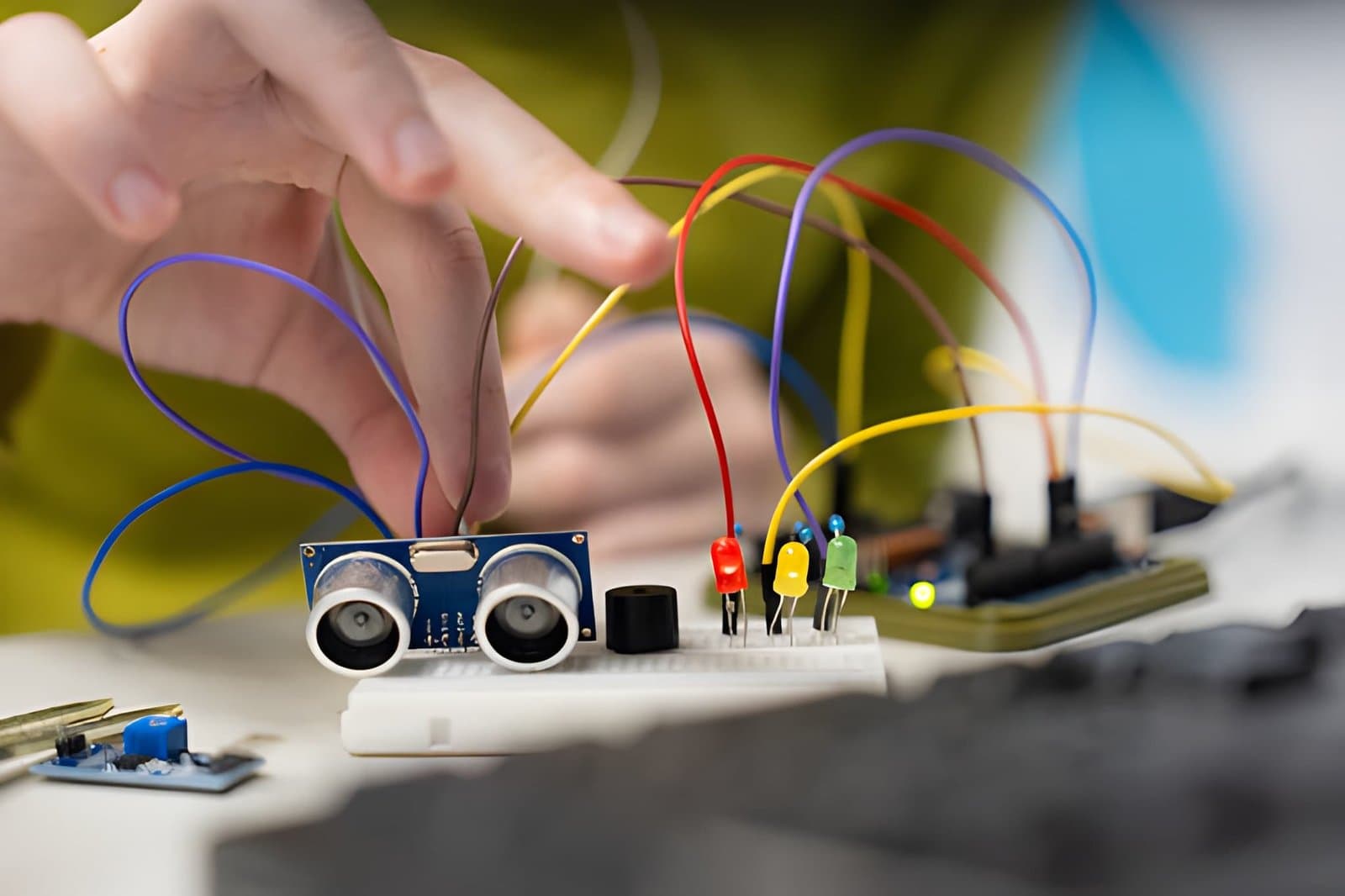
The Rise of Robotics in Indian Schools
Robotics is no longer the exclusive domain of university engineering labs or expensive research facilities. Across India, from metros like Mumbai and Bengaluru to Tier-2 cities like Nagpur and Coimbatore, schools are transforming their science classrooms into mini innovation hubs — and students are thriving.
What's Driving the Shift?
Three forces are converging to make school robotics mainstream in India:
1. Affordable Hardware The cost of microcontrollers like the Arduino Uno has dropped dramatically. A complete starter kit — Arduino, breadboard, LEDs, sensors, and jumper wires — can be assembled for under ₹1,500. What once required a ₹50,000 lab budget now fits in a shoebox.
2. NEP 2020 and Skill-Based Learning The National Education Policy 2020 explicitly calls for experiential learning, vocational skills, and computational thinking from middle school onward. Robotics ticks every one of these boxes. Schools implementing NEP-aligned curricula are finding robotics workshops to be one of the most effective vehicles for the policy's goals.
3. Parental Demand for STEM Careers India produces over 1.5 million engineering graduates annually, yet employers consistently report a skills gap in practical problem-solving. Parents who understand this dynamic are actively seeking schools that give their children a head start through hands-on STEM exposure.
What Students Actually Learn
The most common misconception about school robotics is that it's primarily about building robots. It isn't. The robot is the context — the learning happens in the process:
- Logical thinking: Writing code that controls hardware teaches cause-and-effect reasoning in a way that no textbook can replicate
- Debugging skills: When an LED doesn't light up, students learn to systematically isolate the problem — a skill that transfers to every domain of life
- Collaboration: Most robotics projects are team-based, mirroring how real engineering teams work
- Resilience: Failure is part of the process. Students who build robots learn to iterate rather than give up
Good to Know
A 2024 survey of 200 schools across India found that students in robotics programs scored 18% higher on logical reasoning assessments than their peers in traditional science classes.
The CBSE Connection
Many educators worry that robotics will distract from board exam preparation. The evidence suggests the opposite. When students build a circuit to demonstrate Ohm's Law rather than just reading about it, they remember the concept better and score higher on related exam questions.
CBSE's own curriculum for Classes 6–10 includes chapters on electricity, motion, forces, and environmental science — all of which have direct robotics applications:
- Class 7: Motion and Time → servo motors and speed control
- Class 8: Force and Pressure → gripper mechanisms
- Class 9: Work and Energy → motor efficiency projects
- Class 10: Electricity → complex circuit design
What Good Robotics Education Looks Like
Not all robotics programs are created equal. The best ones:
- Connect to curriculum: Every project maps to a chapter, not just "cool stuff"
- Progress in difficulty: Students start with simple LED blink and graduate to sensor-based automation
- Include theory: Hardware without software context creates tinkerers, not engineers
- Assess process, not just product: Did the student understand why the circuit worked?
Looking Ahead
India's robotics education market is projected to grow at 22% CAGR through 2030. But more important than market numbers is what this means for students: a generation that grows up comfortable with hardware, software, and the space where they intersect is a generation prepared for the economy of the 2030s.
The shift is already happening. The question for schools is not whether to adopt robotics — it's how quickly they can build the infrastructure to do it well.